
The scale at a glance
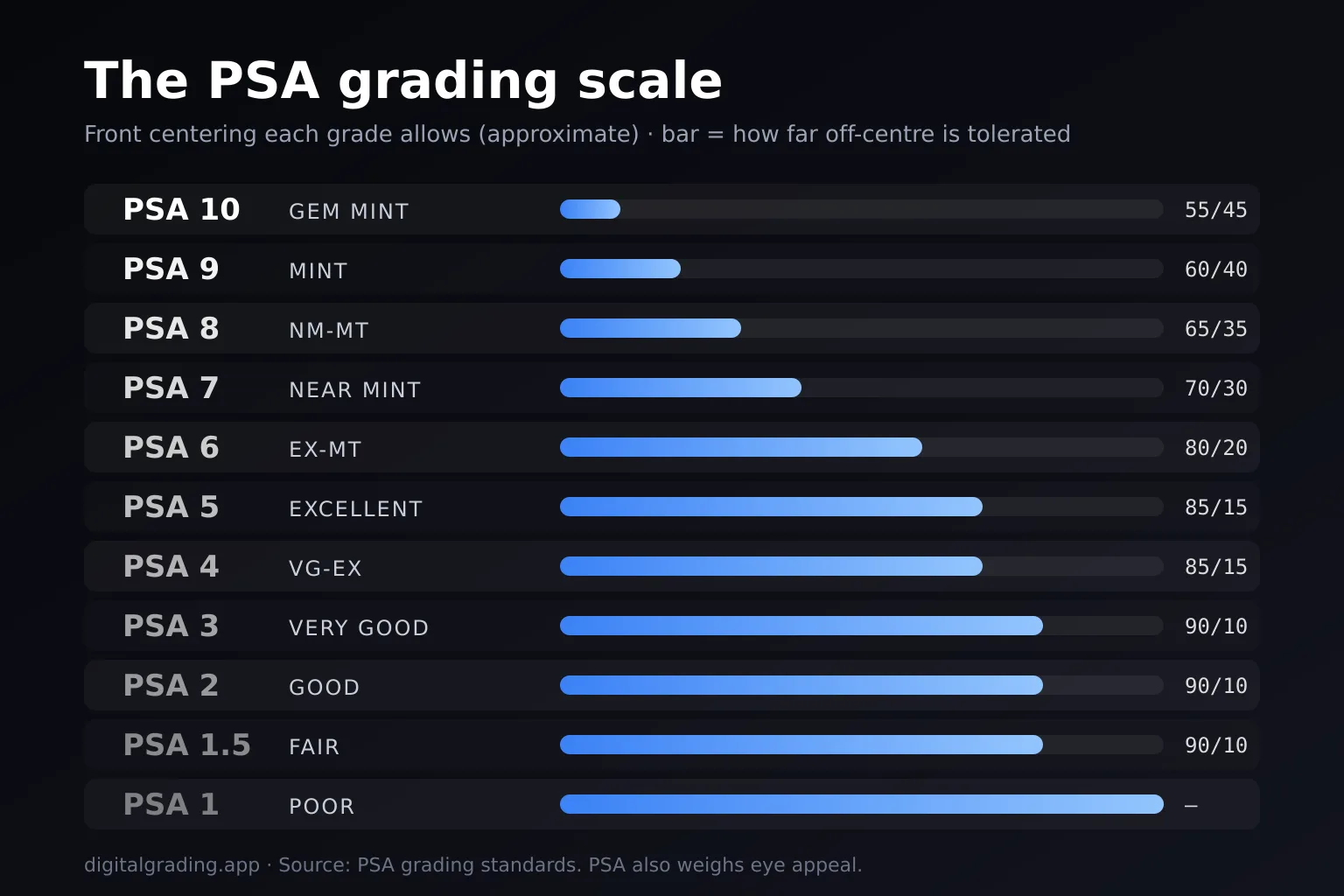
The table lists each PSA grade, its official name and the approximate centering it allows. The PSA 10 figures were checked against PSA's grading standards page on 21 November 2026; the lower grades follow PSA's published scale. PSA also judges overall eye appeal, so a centering figure is a limit, not a promise.
| Grade | Name | Front centering | Back centering |
|---|---|---|---|
| 10 | Gem Mint | 55/45 or better | 75/25 or better |
| 9 | Mint | 60/40 | 90/10 |
| 8 | Near Mint-Mint | 65/35 | 90/10 |
| 7 | Near Mint | 70/30 | 90/10 |
| 6 | Excellent-Mint | 80/20 | 90/10 |
| 5 | Excellent | 85/15 | 90/10 |
| 4 | Very Good-Excellent | 85/15 | 90/10 |
| 3 | Very Good | 90/10 | 90/10 |
| 2 | Good | 90/10 | 90/10 |
| 1.5 | Fair | About 90/10 | About 90/10 |
| 1 | Poor | No fixed limit | No fixed limit |
What separates a 10 from a 9
A PSA 10 is a virtually flawless card: sharp corners, original gloss, sharp printing and no staining. PSA may allow a very slight printing imperfection if it does not hurt the card's appearance. A PSA 9 is nearly flawless but has one small issue, such as a minor printing flaw, a slightly imperfect corner or centering a little wider than a 10 allows.
That is why a card that looks perfect at arm's length can come back a 9. The difference is often something you only see under magnification or angled light: a fleck of whitening on one back corner, a faint print line, or centering at 57/43 rather than 55/45. Measuring centering yourself removes one of those surprises before you submit.
PSA 10 centering on the front and back
PSA's published Gem Mint guidance allows more centering variation on the back. Compare each side with its own guidance: approximately 55/45 on the front and 75/25 on the back. Measure both axes on each side and take the wider split for that side.
For example, a card with 60/40 front centering and 70/30 back centering is outside the usual front guideline, even though the back fits. A card with 55/45 on the front and 80/20 on the back is outside the usual back guideline. Use the centering calculator to check each side and keep the result in context. PSA also considers eye appeal and the physical condition of the card.
Grades 8 to 5: wear you can see up close
A PSA 8 can look like a 9 at first glance, with slight corner fraying, a minor print defect or somewhat weaker centering. At a 7, handling becomes visible on close inspection: light corner wear, minor surface wear or a small printing flaw. A 6 shows wear you can see without magnification, and a 5 has visibly rounded corners and a duller surface.
For valuable vintage cards these grades can still be worth submitting, because a mid-grade copy of a scarce card can be worth more than a high grade of a common one. For modern cards, the drop in value from a 10 to a 7 or 8 often means the grading fee is not covered.
Grades 4 to 1: heavy wear
From a 4 down, wear dominates: creases, scuffing, rounded corners, discoloration and, at the bottom of the scale, paper loss or severe damage. A PSA 1.5 (Fair) is a heavily worn card that still presents a little better than a PSA 1 (Poor).
Low grades are not worthless. For rare and historically important cards, an authenticated low-grade copy can still carry a strong price, because the grade confirms the card is genuine.
Qualifiers: a grade with a note attached
PSA can add a qualifier to a grade when a single significant problem is not fully captured by the number. A card graded 8 (OC) is in 8 condition apart from its off-centre printing, for example. Qualified cards usually sell below an unqualified card of the same number.
| Code | Meaning |
|---|---|
| OC | Off-centre beyond what the grade allows |
| ST | Staining |
| PD | Print defect |
| OF | Out of focus or misregistered printing |
| MK | Marks: writing, ink or pencil, or impressions from writing |
| MC | Miscut: a factory cutting problem, sometimes showing part of another card |
When PSA won't give a number
Sometimes PSA inspects a card and returns it without a numeric grade. Each outcome has a code, and knowing them helps you avoid sending cards that are likely to be rejected, such as anything that has been cleaned, pressed or trimmed.
| Code | Reason |
|---|---|
| N1 | Evidence of trimming |
| N2 | Evidence of restoration |
| N3 | Evidence of recoloring |
| N4 | Questionable authenticity |
| N5 | Altered stock (for example pressing or surface alteration) |
| N6 | Below the minimum size |
| N7 | Evidence of cleaning |
| N8 | Miscut |
| N9 | PSA does not grade the item |
Check what you can before you submit
Of the things PSA judges, centering is the one you can measure precisely at home. The free centering calculator on this site shows the highest PSA grade your card's centering allows, front and back. Corners, edges and surface need a close look under angled light, and a daig scan flags where to look.
None of this predicts PSA's final number, which depends on the physical card and PSA's judgement. If you are considering another grader, compare PSA, Beckett and CGC on the holder, comparable sales and total service cost.